3.15.2012

Moving to a new blog

I've been blogging from this address since 2006, but am changing sites.

You can now follow my research and writing on Pueblo Lands, a blog that will be much more focused on politics and economics in California's Bay Area. Stay tuned by following me on Twitter where I'll post updates.

"Pueblo lands" refers to one of the earliest and most formative political struggles in California's history when the state's existing urban commons, organized by the Spanish and later Mexican governments and protected by the Treaty of Guadalupe Hidalgo, were illegally sold off to a handful of wealthy Anglo speculators. Los Angeles, San Diego, and most of all San Francisco lost an immense opportunity to found themselves on common wealth in public land, to provide housing security for their residents, and develop cities to benefit workers rather than real estate capital. Instead an injustice was perpetuated, albeit in a new form, upon the genocide of California's native peoples.

My renewed focus on the San Francisco Bay Area is motivated by a desire to critique the existing political economy, and to hint at what's still possible.

2.29.2012

The Great Swaparoo

Remember that wacky "free money" guy with the question mark suits?

Matthew Lesko's infomercials became infamous in the 1990s because he offered something seemingly impossible - a free source of income that could be tapped by even the stupidest person. In pop culture he's now basically synonymous with fishy scams and dangerous financial schemes (even though his shtick was simply to point out various government grants and assistance programs).

Lesko's basic sales pitch - "FREE MONEY!" - was pretty effective when used by bankers on public officials and civil servants in local governments across the US over the last decade and a half. Cities, counties, and local agencies staked huge sums of public revenue on the idea that they could generate free money by entering into complex financial deals called interest rate swaps with Wall Street. It was supposed to be a win-win game. Instead the deals have gone toxic for local governments.

I've been writing about IR swaps lately for some local publications in the Bay Area. The gist of it is that, as bloomberg reporters pointed out recently, local governments across America have been drained of upwards of $20 billion in revenues by Wall Street's titans. Meanwhile the Obama administration, Congress, and federal regulators in the Federal Reserve Bank and US Comptroller's Office sit idly by, offering no plans to bail out local communities.


Oakland's Toxic Deal With Wall Street - How Goldman Sachs is Taking Millions from Oakland Taxpayers While the City Guts Services

The Losing Bets - San Francisco and Bay Area Public Agencies Are on the Hook for Millions in IR Swap Payments to JP Morgan, Morgan Stanley, Wells Fargo, Goldman Sachs, and other Wall Street Titans.


1.16.2012

SMS Holdings: The "Faith-Based," Anti-Labor Company Behind Oakland's Private Cops

Even as Oakland prepares to lay off 200 workers due to its shrinking budget and loss of Redevelopment Agency funds, the city will continue to pay $197,000 in property assessments to the Downtown Oakland Association, and Lake Merritt Uptown District Association, the two non-profits that manage the downtown business improvement districts. In turn, much of this money will be paid to Block By Block, a Louisville, Kentucky company that specializes in providing security for business improvement districts. Block By Block is a subsidiary of the Nashville, Tennessee headquartered SMS Holdings, a powerful, politically connected private corporation with a shady record of attacking unions and relentlessly hollowing out the pay and benefits of its employees.

SMS Holdings describes itself in company literature as a "God-centered, faith based" business. Its seven subsidiaries (Valor Security, Service Management Systems, PrimeFlight, FirstLine, Brantley Security, ServiceWear, and Block By Block) have attacked unions attempting to organize workers in airports, shopping malls, and business districts across the country. On the web sites of various anti-union consulting firms, SMS Holdings is listed as a satisfied customer, employing these modern-day Pinkertons to derail unionization drives and negotiations. Executives of SMS Holdings, however, are by no means critics of big government. Over the last decade they have cultivated strong —some might even say corrupting— ties to members of Congress in order to win lucrative, multi-million dollar security contracts at airports and other federal facilities where its holds lucrative contracts.

SMS Holdings' presence in Oakland, and the money it receives from the city's share of business improvement district assessments, raises important questions about the continuing privatization of city services, and subsidies Oakland is paying to security firms and real estate corporations, even while schools are closed and city services are axed.


Oakland's Costly BID Assessments

Oakland's contributions of public revenues to the DOA and LMUDA districts are significant commitments for the cash strapped city. This year Oakland taxpayers must provide the DOA with $109,904 because of assessments on five city-owned properties in the district's boundaries, including City Hall. Unlike most other taxes, public properties are not exempt from BID assessments.

According to the DOA's own assessment records the City of Oakland is by far the largest single contributor to the district's budget, a fact that somewhat undermines claims made by business leaders who say the advantage of the BIDs is that they provide special benefits through the assessment of private property owners.

The city is paying the Lake Merritt Uptown District Association another $52,068 this year. According to the LMUDA's records, the City of Oakland is the sixth largest funder of the district. What's more is that these assessments will increase five percent next year, and each year after.

When the City Council approved of creating the DOA and LMUDA in 2008, staff members of the Community Economic Development Agency noted that fiscal commitments over the 10-year lifespan of each district would be $1.58 million and $566,000 respectively. CEDA staff characterized these obligations of public dollars as "strategic and productive investment of public funds." Alternatively, one could just as easily frame the city's payments as a multi-million dollar subsidy for the large real estate companies who reap the benefits from these special assessments in the form of extra security, cleaning, landscaping services, public relations, lobbying, and special events that they pay far less for because of the city's contributions.

Adding further costs to Oakland's financing of these special districts is the elimination of the Redevelopment Agency. Losing these state-provided funds, the City of Oakland must now pay out of the General Pool Fund for the assessments of the four former Redevelopment Agency owned properties in the DOA. These properties were assessed at $30,438 in 2008. That means that this year the City will likely have to pay about $35,235, and this sum will increase 5% each year after.

Block By Block's contract with the business districts is one of the largest single expenses. According to the DOA and LMUDA's joint 2009-2010 Annual Report to the City Council, "Block By Block receives approximately $60,000 per month from both organizations...." That's roughly $720,000 per year of Oakland tax dollars being paid to SMS Holdings. This includes both assessments on private property that fund the DOA and LMUDA, and the city's $197,000 or so in funding for the district's.


The SMS Holdings Way

SMS Holdings was founded in 1988 as a janitorial services company in Nashville, Tennessee. It quickly grew into a multi-million dollar corporation through large service contracts cleaning office buildings. In the late 2000s SMS Holdings went on a growth spurt, buying up security companies. Among these was Block By Block, the Louisville, Kentucky firm that controls a large share of the market for "security ambassadors" and cleaning services provided to business improvement districts. Block By Block contracts with forty-two BIDs across the United States, including Oakland and Berkeley. By 2008 SMS Holdings posted revenues upwards of $300 million. The company's vice president predicted then that it would surpass a half-billion by 2011.

Image from "The SMS Holdings Way," company pamphlet.
A document entitled "The SMS Holdings Way," available on the company's web site, reveals the religious beliefs of its owners and executives: "from our company’s beginning, our business philosophy has been God-centered and faith-based. While we will always show tolerance and acceptance of the personal beliefs of others, we recognize that there is a higher order that provides a basis for all of our core values."

It's unclear just how deeply the Christian faith and beliefs of SMS Holdings' owners and executives shapes company policy, but in another area the results are much clearer. Block By Block and other SMS subsidiaries maintain low-wage, anti-union workplaces, and have been very aggressive over the past decade in lobbying federal legislators to privatize thousands of government jobs. Block By Block in particular has been criticized in several cities for privatizing services and opposing unionization drives among its employees. SMS Holdings' other subsidiaries have worse records. Paying minimum wages-levels (and in some workplaces even less), SMS Holdings has been able to skim enormous profit margins off of government outsourced jobs.

Block by Block employees are paid much less than municipal employees, especially unionized city workers. In Minneapolis the company's "Clean and Safety Ambassadors" were initially paid $11.50 an hour. Guards Valor Security Services are paid about $10.25 an hour, according to job listings in different states, while workers with PrimeFlight Services rarely make more than state minimum wages (including tips), and in some cases less. When Block By Block's workers successfully unionized with SEIU Local 26 in Minneapolis their wages were boosted to $13.22, levels still far below the living wages municipal public works employees are paid there and elsewhere.

In Pittsburgh Block By Block's security ambassador employees faced a different situation. When they attempted to unionize through the SEIULocal 32BJ, Block By Block managers opposed the simpler card check process, pressing instead for a secret ballot election, a union formation method that gives employers more tools to scuttle pro-union outcomes. Block By Block management barred employees from wearing union buttons or talking to the media, and according to reports in the Pittsburgh Gazette even conducted surveillance and called the police when some of their ambassadors passed out pro-union literature in front of the Pittsburgh Downtown Partnership's offices.

In a Nashville Business Journal article last year the chief development officer of SMS Holdings, Jim Burnett, told a reporter that for cities, "there’s a need to conserve, and so the private sector is an option that’s available to them." The article continued: "Burnett believes business opportunities through privatization are 'imminent.' SMS and other local companies — including Nashville prison operator Corrections Corp. of America and inmate health care provider America Service Group of Brentwood — acknowledge the heightened opportunities while saying they find interest in their services regardless of which party is in power." (More about Burnett below.)

In Oakland, where Democrats and "progressives" have a virtual monopoly on government, the city's chronic budget crunch has created favorable conditions for the formation of the publicly subsidized, privately managed business improvement districts that have hired Block By Block to patrol the downtown. Burnett's company is doing quite well here.


A Tangled Web of Political Connections

Block By Block appears to be a relatively small, but growing, segment of SMS Holdings. The company's most profitable ventures in recent years instead have been private security and aviation service workers whose ranks were greatly expanded with the creation of the Department of Homeland Security, and then privatized en masse by the Bush administration. These SMS Holdings companies reveal not only the extensive political connections the company has cultivated to obtain contracts and shape federal policies, they also provide a window into its extremely anti-union practices.
SMS Holdings owns two private security corporations, Valor and Brantley. Brantley specializes in guarding corporate and government campuses, schools, and residential communities. Valor's business is mostly with large shopping malls and hotels. 

Valor's own employees have attempted to unionize before in several locations, but the company's managers have strongly opposed these efforts. A search of job listing posted by Valor on different web sites reveals universally low pay, rarely greater than $11 an hour. Anti-union shopping mall owners such as General Growth Properties —which has been embroiled in a battle with the SEIU for years over unionization attempts among its janitorial staff— is a major employer of Valor guards. Valor Security guards have been criticized for harassing other mall workers who have attempted to organize. One alleged incident in Heyward, California Valor guards were said to have assaulted janitors during a union drive in 2007.

Michael Rosado, an anti-union consultant, mentions SMS Holdings on his web site as a customer. Under the heading "Union Avoidance Campaign Victories/Withdrawals," Rosado includes SMS Holdings, explaining that his firm helped SMS avoid unionization attempts by employees seeking to join the UFCW at two Kentucky shopping malls. Rosado's web site doesn't explain anything further about this episode, but strangely his company uses the same image of the interior of a shopping mall that appears on Valor Security's website describing its "shopping center marketplace" services. In an October, 2011 blog post on his company web site, Rosado warns corporate managers "don't be fooled." He claims, "unions are out in full force, taking advantage of and positioning themselves at the OWS [Occupy Wall Street] rallies."

PTI Labor Research's web site, including testimonial from SMS Holdings.
Another anti-union consulting company's web site mentions SMS Holdings as a customer. PTI Labor Research features Bill Stejskal, vice president of human relations for SMS, among its client testimonials. “To defeat your opposition," Stejskal is quoted as saying, "it is best to know your opposition. PTI has assisted us by providing hard facts about our opponent labor unions that the unions would have preferred to have kept hidden from our employees. The great difficulty the unions had trying to explain away their unflattering pasts and their questionable current practices made a great impact on our employees."

SMS Holdings' aviation services companies by far have the worst labor records. Primeflight specializes in providing service workers to airports and airlines. At the George Bush Intercontinental Airport in Houston where Primeflight workers drive passengers through terminals, company managers have pressured less-than-minimum-wage employees to over-report tips in order to qualify SMS Holdings for lucrative state subsidies, and to justify extremely low wages. The Houston Chronicle reported on November 1, 2011 that Primeflight's participation in the state subsidization program have been suspended, and that the company is being investigated.

The most profitable anti-union activities of SMS Holdings have been directed at workers employed by its FirstLine Transportation Security subsidiary. Firstline contracts with the Department of Homeland Security to provide airport security screeners at eight locations including Roswell, New Mexico and Kansas City, Missouri.

In 2003 the federal Department of Transportation determined that TSA screeners in airports could not legally form unions, ostensibly because of national security concerns. The ruling was highly profitable for FirstLine which was already contracting in several US airports, and working to vastly expand its ranks of screeners.

That ruling did not hold for long. Firstline employees at the Kansas City International Airport began to organize, seeking representation through the International Union, Security, Police and Fire Professionals of America. SHS Holdings attacked the union and its employees by appealing an election through the National Labor Relations Board. The company was backed by the National Right to Work Legal Defense Foundation, among other conservative, anti-labor organizations.

SMS Holdings' power to combat the unionization of its workforce was greatly enhanced by the political ties the company's executives had cultivated since the early 2000s. According to Federal Elections Commission data, executives of SMS Holdings contributed over $100,000 to the campaigns of congressional representatives since 2003. Much of this money was funneled through the FirstLine Transportation Security PAC.

This flow of campaign cash was focused largely on a few legislators whose powerful appointments on several congressional committees gave them oversight powers over TSA contracts sought by SMS Holdings. Among those who benefited from SMS Holdings contributions were House members John Mica (R-FL) and Dan Lungren (R-CA).

Rep. Mica is the current Chairman of the House Transportation and Infrastructure Committee. Rep. Lungren holds a seat on the House Subcommittee on Transportation Security. Both positions allow them to shape legislation impacting contracts held by SMS Holdings.

In the Senate John Thune, Jim DeMint, members of the Aviation Operations, Safety, and Security Subcommittee have been recipients of Firstline PAC money as well as contributions directly from SMS Holdings' executives.

Tight political connections that have allowed SMS Holdings to fight unions and obtain lucrative government contracts don't stop there. In 2003 the company hired Jim Burnett (quoted above on privatization as a business opportunity) to be its vice president of business development. Burnett previously was chief of staff to Van Hilleary, a US House member representing suburbs of Nashville.

When Rep. Hilleary quit his seat in 2004 he moved to Washington, D.C., working as a consultant at the powerful SNR Denton lobbying firm. Among his clients was SMS Holdings. In 2006 Van Hilleary ran for Senate. Financial disclosures filed then revealed he had lobbied extensively for SMS Holdings with his former congressional colleagues. Among the largest funders of his senatorial campaign were SMS Holdings executives.

These political connections continue to work for FirstLine and SMS Holdings. As recently as November of 2011 Rep. John Mica was arguing still for privatizing all TSA screening jobs.

...And Oakland is paying these people for private security guards.

1.14.2012

Whose Streets?

Part 2., Big Business' Occupation of Downtown Oakland

In our first installment in this series we gave an overview of the emergence and role of business improvement districts in Oakland, CA and beyond. We described how they allow real estate corporations to circumvent tax-revolt era laws that have starved many de-industrialized, majority-minority cities, in order to fund projects that are aimed at gentrifying neighborhoods to increase rents. We introduced two of Oakland's BIDs, the Downtown Oakland Association, and the Lake Merritt/Uptown District Association (DOA and LMUDA), and revealed their efforts to eliminate Occupy Oakland's encampment. In this piece we extend that analysis with more background on the political agendas of the DOA and LMUDA.

Since early 2009 a different kind of "occupation" in downtown Oakland has been reshaping public space and transforming the underlying relationship between government and the people. It's not a protest. There are no tents, banners, rallies or marches. Instead this occupation has taken hold through subtle but profound changes in state and local laws. The leaders of this occupation are a small group of major real estate companies. Their ultimate goals stand in stark contrast to the economic reforms and  greater democracy the Occupy Oakland protesters say they are seeking.

Oakland's two largest business improvement districts, the Downtown Oakland Association (DOA), and Lake Merritt Uptown DistrictAssociation (LMUDA) have been praised over the last three years by politicians and the media for spurring a "renaissance" in one of California's most economically depressed cities. Both organizations have mostly avoided criticism, until very recently when they pressured Mayor Jean Quan and the Oakland Police Department to wipe out the Occupy Oakland encampment in Frank Ogawa/Oscar Grant Plaza. Their stance against Occupy Oakland led many observers to question why both special districts were so adamant about removing the encampment, even if it required violent police raids.

What the DOA and LMUDA's own records show, however, is that the forceful crackdown against Occupy Oakland they encouraged wasn't a one time position. In lock-step (both districts are governed by virtually the same board members, and managed by the same San-Diego-based consulting company) the DOA and LMUDA have waged a concerted campaign since their creation in 2009 to radically transform downtown Oakland. This transformation, according to the groups' own records, is explicitly intended to remove youth of color, the homeless, political activists, and virtually anyone else who does not conform to a desired upper-income consumer demographic. Policing, both private and public, has been central to this campaign.


Militarizing Public Space

The DOA and LMUDA's attempts to eradicate targeted populations from downtown Oakland are most evident in proposals to redesign or eliminate particular spaces where youth of color, the homeless, and even taxi cab drivers congregate. Spaces that the BIDs have been particularly focused on transforming or eradicating include the sidewalk surrounding Burger King on 13th and Broadway, the taxi stands on 13th, ledges around the BART station entrances, Snow Park, and Franklin and Latham Squares, and Frank Ogawa/Oscar Grant Plaza.

In "Uptown" —the favored name used by corporate developers to identify the blocks bounded by Harrison Street, Grand Avenue, San Pablo Avenue, and 17th Street— the LMUDA is attempting to erase public spaces where "undesirable" persons congregate. Part of this strategy involves placing planters on the sides and backs of the 17th and 19th Street BART station entrances in order to eliminate places to sit. The LMUDA also claims that the homeless are "targeting Uptown," and minutes from the district's April 21, 2009 board meeting reveal that "homeless encampments in district will require coordinated effort with maintenance team," to remove them. Occupy Oakland wasn't the first encampment to be targeted for removal by Oakland's BIDs.


From OPD pamphlet.
In order to drive poor people out of the LMUDA district boundaries the organization has distributed OPD anti-panhandling flyers to building owners and apartment managers. They in turn have distributed these among the new upper-income residents of the luxury apartments and condos concentrated Uptown. Furthermore the head of LMUDA's private security, Ted Tarver of Block By Block, has pressured the Oakland City Attorney, OPD, and the City Council to prioritize the enforcement of laws against sidewalk sales in an effort to eliminate street vendors and panhandlers, according minutes of the district's "Sidewalk Order and Beautification Ordinance" committee from April 20, 2011.

Before taking over Block By Block's security operations for the DOA and LMUDA, Tarver was a 16-year veteran of the San Francisco Police Department. Block By Block specializes in contracting with business improvement districts for security and other services. It is a subsidiary of SMS Holdings, a Nashville headquartered firm that owns six similar companies. SMS Holdings describes itself as a "God-centered and faith-based" business in company literature, and is known for the anti-union policies of its management.

At Burger King on 13th and Broadway, the Downtown Oakland Association has proposed several measures to drive away persons characterized by the DOA as "pan handlers" and "loiterers." Seeking to eliminate poor people from this corner, the DOA, working through Ted Tarver, has convened meetings with the owner of the Burger King franchise, and the owners of the buildings immediately adjacent to the corner, in efforts to coordinate increased security patrols. The DOA's board meeting notes from March, 2009 boast that "[Block By Block] Ambassadors have greatly reduced the pan handling, loitering."

Taking further steps the DOA has researched the costs and jurisdictional logistics of installing planters on the ledges that wrap around the BART station entrance in front of the Burger King because "people use it as a bench," and it "encourages hanging out." The DOA defines "hanging out," and "using benches" as bad behaviors that must be eradicated. In one of their "District Identity and Streetscape Improvements" committee meetings, the DOA's board and staff discussed installing bulky landscaped planters as a means to "take up space and move people away from the corner."

Furthermore the DOA has allocated thousands of dollars toward eventual installation of a Muzak system —piped music and sound effects— to drive away "undesirable people from the area," as minutes from an April, 2009 board meeting reveal. Toward this effort the DOA has pressured business owners on the block, including the owner of the Burger King franchise, T-Mobil, Fred Karren (the owner of the building), and Mo Mashoon, owner of the building across 13th Street, to each contribute $2,000 yearly toward this audio deterrent.

Across 13th Street from the Burger King the DOA has advocated for the removal of taxi cab spots in the diagonal street parking because the corner "already has a loitering issue," and they want to remove the cabbies from the sidewalks where they take breaks and wait on fares. Oakland's cabbies, it should be noted, are primarily working class men of color. The DOA claims they are hanging out too much, and that their presence deters shoppers and corporate employees from frequenting the area.


Claiming Space

The 13th and Broadway site has become a zone of racial and class surveillance and policing of "undesirables" because it is the very core of the Downtown Oakland Association district. The DOA has chosen this intersection to install light pole banners with its logo, much like any occupier plants a flag claiming space.

SKS Investments' planned office tower.
Immediately across Broadway is the Clorox Company's office tower. Clorox is one of the district's largest corporate property owners with a controlling interest in the DOA's assessments and votes. Besides having its headquarters and own employees there, Clorox is now renting out much of its own building —seven floors, or 136,000 square feet to be exact— making the company one of Oakland's biggest landlords. Just around the corner on 12th and Broadway SKS Investments, a San Francisco headquartered real estate developer that was a major player in the gentrification of SOMA in decades past, is planning to build a 20-story office building. SKS Investments has a representative on the DOA board alongside Clorox and other major real estate owners in downtown Oakland like CIM Group, CAC, CBRE, Metrovation, California Capital Investment Group and a handful of others.

These concentrated corporate real estate owners are able to dominate the boards of the DOA and LMUDA and determine the policies of both districts because the law governing formation and management of business improvement districts (the Property and Business Improvement District Law of1994, CA Streets and Highways Code 36600 et seq.) apportions votes based on the percentage of the  assessments each owner provides to the district's total budget. He who has the gold, makes the rules. Only property owners may vote on nominees for the district's board. Furthermore, it only takes a simple majority of votes held by the owners of assessed property to form and steer a district.

Phil "Shotgun" Tagami in his Rotunda Building.
According to data compiled from the DOA's initial assessment survey, a mere nine property owners together control more than 50% of the assessed property values in the district. Key among these are CBRE, the global real estate firm owned by Senator Diane Feinstein's husband Richard Blum; Phil Tagami, the owner of several downtown Oakland properties including the Rotunda Building which he infamously patrolled with a shotgun during Occupy Oakland's general strike; the CIM Group, a major LA-based real estate investor; and the previously mentioned SKS Investments and Clorox.

The LMUDA district, located north and east of the DOA's boundaries, is also controlled by an elite group of corporate real estate owners. According to assessment records obtained from the district, a mere twelve property owners numerically account for more than 50% of assessed property. The inner circle of the LMUDA overlaps very much with the DOA. The CIM Group and CBRE have representatives on the board. Other controlling interests include the Swig Company, a San Francisco real estate developer that owns the Kaiser Center and has holdings across California, in Texas, New York, New Jersey, and Washington, D.C.; Kaiser Permanente; Brandywine Realty Trust, one of the nation's largest REITs, based in Pennsylvania; Metrovation, another San Francisco real estate developer with national holdings; and Signature Properties, an Oakland-based developer.


Coordinating, Transforming, and Intensifying Police Force

Just prior to forming the DOA and LMUDA in 2008, the soon to be executive director of both organizations, Marco Li Mandri, wrote to the above set of corporate real estate owners in Oakland explaining how the district would allow them to obtain not only special assessment funded services, including security, but also how it would allow them to lobby for greater general city resources, including policing; "Experience has shown that once the assessment district management corporation is formed, the private property owners in the district can normally leverage a greater amount of general benefit City services than before the establishment of the district.This is due to the fact that those property owners are now organized...."

Since their formation Oakland's two downtown BIDs have attempted to coordinate and focus city police force on the downtown, in addition to beefing up security with their own private guards, called "ambassadors."

From very early on both BIDs have organized meetings with OPD leadership and officers in an attempt to seamlessly integrate the district's security guards with OPD. OPD officers, however, have been resistant to cooperating with Block By Block's ambassadors. This resistance is partly born of OPD's internal culture which disparages private security guards, and partly from the fact that OPD leaders and the police union leadership are intent on setting their own priorities.

Even so, OPD commanders have shown much deference to the BIDs and their agenda for the downtown. OPD Captain Anthony Toribio told the DOA board in December 2009 that the department supports joint patrols of OPD officers and Block By Block security, and that these private cops could act as a "force multiplier." In another meeting Captain Toribio told the LMUDA board he wanted the district's private security to "share intelligence" with OPD.

Captain Toribio suggested to the DOA that its board and staff should lobby the Alameda County District Attorney's office to press for stricter enforcement and sentencing of those targeted by Block By Block, and cited by OPD for various misdemeanors in the downtown, so as to drive these persons away permanently. The DOA board has also strategized with Captain Toribio as to how the district could most effectively pressure the City Council to increase the number of cops patrolling downtown Oakland. Similarly in a March, 2009 board meeting LMUDA members discussed petitioning the city to pay for more police to patrol "Uptown" so as to create a greater sense of security during events like the Art Murmur.

Upon hiring Block By Block as its security contractor, both the LMUDA and DOA have sought ways to fully integrate their private police force into the OPD. Early on Block By Block ambassadors were allowed to attend OPD daily lineups. According to notes from a December, 2009 LMUDA board meeting, OPD officers receive "weekly security updates" drafted by Block By Block security chief Ted Tarver.

At the same meeting Tarver, Captain Toribio, and the LMUDA board discussed ways to discipline OPD officers who continued to resist pressures to work with the LMUDA's hired security force: "Officers that do not like them and are resistant to work with them will be held accountable," read the minutes from the board meeting. Captain Toribio recommended that BBB security staff "record the car or badge number" of cops who refuse to cooperate with them, and "he will follow up with [the officers]."

Another means by which the DOA and LMUDA are "force multiplying" police and private security downtown is via technology. Block By Block initially sought permission for its security ambassadors to carry OPD radios. Due to police resistance, and because this could be a violation of the law, it was decided instead that OPD officers would carry Nextel phone/radios used by Block By Block staff. The next stage of this kind of "intelligence sharing" will involve hand-held devices that allow Block By Block ambassadors to track individuals and activity in the downtown, in real time, sharing it with OPD, and storing data for later analysis.

This system is being developed by Eponic, a Portland, Oregon-based company. Eponic's web site explains that they "develop mobile software and management solutions specifically for Business Improvement Districts, Urban Developers, Cleaning and Security Providers." Block By Block is exploring this technology for use in Oakland's downtown BIDs, according to board meeting minutes.

Former Oakland Police Cheif Anthony Batts is listed on Eponic's web site as a supporter. While heading up the Long Beach Police Department, Batts even endorsed the company's tracking software and devices. In a letter to the International Downtown Association, an industry lobby for BIDs, Batt's explained how this technology facilitates policing of the homeless, youth of color and other populations universally targeted for removal by BIDs.

"Guides are able to track on their PDAs trends in graffiti, illegal dumping, abandoned shopping carts, and quality of life issues such as panhandling and outreach to the homeless community. For instance, the Long Beach Police Department is responsible for enforcing curfew in a Downtown park where many homeless individuals tend to congregate," explained Batts. "The Guides are able to note the number of individuals in the park after curfew in their PDAs and send the data to us," whereupon the LBPD would cite, arrest, and otherwise remove these homeless persons.

As a result of Chief Batts' endorsement, Eponic and the Downtown Long Beach Association (a BID just like Oakland's DOA and LMUDA) won the International Downtown Association's 2007 Merit Award, beating out similar police-state/private security technologies developed in Cape Town, South Africa, and Cincinnati, Ohio.

While Chief of the Oakland Police, Batts was very supportive of the downtown BIDs.


The Oscar Grant Rebellion

Few specific examples better illustrate the political agenda of the DOA and LMUDA than their reactions to the protests following Oscar Grant's slaying by BART police officer Johannes Mehserle on New Years Day 2009.

Swig Co.'s Kaiser Center.
Less than two weeks after frustrated Oaklanders marched on the downtown and faced off against the police, the LMUDA held a board meeting in the Swig Company's lakeside Kaiser Center tower. LMUDA directors, including representatives of Swig Co., Portfolio Property, Kaiser Permanente, CAC Beacon, Signature Properties, and CIM Group held a lengthy strategy session about how to defuse the nascent movement against police brutality, specifically because the situation was inconveniencing property owners and undermining the district's public relations campaign to re-brand downtown Oakland.

According to minutes from the LMUDA's January 20th board meeting, the district's staff were tasked with looking into why 14th and Broadway was a site of protest, what the city's process for issuing march permits was, and how the LMUDA and DOA could perhaps block issuance of these permits. Both BIDs tasked their staff with lobbying City Hall to move any future protests outside of the district, but especially away from 14th and Broadway and Frank Ogawa Plaza, which the DOA considers its domain.

Furthermore, the BIDs discussed ways to support removal of the impending trial of Mehserle from Alameda County, also in an effort to diffuse future protests. Mehserle's lawyer eventually would ask for a move which would be granted.

The BIDs also discussed creating a media strategy to undermine the protesters. LMUDA and DOA board members talked of the "need to counteract this negative press by putting forward the story of the CBDs," another name for the districts. Among some of its own corporate members the LMUDA and DOA were able to raise a $100,000 fund to compensate property owners whose buildings were damaged during the January 7, 2009 rebellion.

The LMUDA and DOA board meetings notes communicate nothing to the effect that these groups contemplated assisting Oscar Grant's family and the community, or that the LMUDA and DOA considered playing a positive role in addressing police-community relations during this tense period.

Instead the BIDs intensified their securitization of the downtown. For the DOA and LMUDA Block By Block set up a series of meetings in which Ted Tarver coordinated with the OPD, BART Police, the Alameda County Sheriff, and other police forces, in preparation to crack down against the protests.

In the aftermath of the trial's verdict, in July of 2010, an Oakland City employee who represented the city on both BID boards asked staff of the LMUDA and DOA and its contractor Block By Block for help "tracking down surveillance footage in an effort to apprehend and prosecute individuals involved in vandalism," according to meeting notes.

In the run up to the November, 2010 sentencing of Johannes Mehserle, Block By Block advocated for the creation of "arrest teams" among police forces, and the strategic placement of officers on each block to deter property damage. Block By Block chief Ted Tarver worked to create a "operation's [sic] manual to address any potential fallout from the upcoming Mehserle sentencing." According to DOA board meeting minutes from October 6, 2010, Tarver and the BIDs convened meetings of "all security managers in the districts, local law enforcement (OPD, BART Police, Alameda County Sherriff's Dept. [sic], the District Attorney's Office, the City Attorney's Office and CEDA to develop a game plan."

When the LMUDA and DOA learned that the sentencing date fell on Friday, November 5, the organizations went so far as to attempt to lobby the California Attorney General and District Attorney of Los Angeles, who they hoped would in turn put pressure the presiding judge to move the sentencing date, because it would conflict with a "First Friday" event, one of the art and culture productions put on by the districts to whip up tourism in Oakland.

According to DOA board meeting minutes from August 18, 2010 "Ted [Tarver of BBB] emphasized that a lot of the damage [from the protest after the July verdict] was cause by so-called Anarchists and not Oscar Grant protestors.  Marco [Li Mandri of New City America] expressed concern over the scheduled date for the Mehserle sentencing.  The date is a Friday and coincides with First Friday.  Efforts are being made to reach out to the District Attorney and Attorney General to try to talk to the judge and request a new date."

After the sentencing DOA and LMUDA staff congratulated themselves on not receiving any reports of damaged properties, and diffusing negative impacts on the districts due to the protests which had by then become subject to enormous police repression.

12.30.2011

Fill 'Er Up

Northern California is a strange land when it comes to real estate development and agriculture. Here's two pieces on a massive terra-forming project in Sonoma County.

The short version:
Fill 'Er Up: A massive South County project has environmental watchdogs guessing

The backstory included:
Berg's Vineyard from Scratch

And in other news, CA seems closer to ditching nuclear energy after the CPUC rejects PG&E's application to pay for Diablo Canyon's re-licensing with ratepayer funds.

12.15.2011

The Corporate Media's Counter-Counter Attack Against Occupy's Port Blockade


Hearst Corporation's NY headquarters.
In spite of a negative propaganda campaign led by the San Francisco Chronicle and parroted in much of the Bay Area's corporate media, thousands turned out on Monday, December 12 to blockade the Port of Oakland.

Organizers for the Occupy movement explained that the blockade was a coordinated counter-strike against WallStreet and its political servants. It was a nonviolent response to the vicious police assaults against most of the nation's Occupy encampments. That violent wave of evictions, carried out through the month of November, was reportedlycoordinated by city officials and local police forces working through the USConference of Mayors. Many suspect the crackdown was also facilitated with assistance from high levels of the federal government's now sprawling internal security force known as the Department of Homeland Security.

Fittingly then, just as the government's nation-wide attack against the Occupy movement began with a "shock-and-awe" style police raid in the early morning hours of Tuesday, October 25 in Oakland, the  movement's coordinated West Coast counter-strike began in the pre-dawn stillness of the same city. Hundreds gathered at the West Oakland BART station at 5am. Massing to over one thousand by 5:30, they marched in the cold and the dark of the city's industrial wastelands to the Port of Oakland, the fifth busiest shipping facility in the United States, and a crucial choke point in the global logistics system relied upon by multinational corporations like WalMart, Nike, and Starbucks.


By 9am word had spread across the city, across the West Coast, and eastward —into landlocked states where on any other day the BNSF and Union Pacific rail roads normally speed containerized cargoes from the Port on massive snaking intermodal trains— that that morning's crew of longshoremen had been notified by their union's arbitrators, the International Longshore Workers Union, not to cross the blockade's lines, ostensibly because of "unsafe" working conditions.

Word spread in spite of reports by the Chronicle and other corporate media, falsely claiming the morning blockade had garnered only only a few "hundred" picketers. Many of the ILWU rank and file gladly took the day off, even if some would have preferred to earn that day's wages.

The Chronicle had  deceivingly reported the union's position and the sentiments of longshore workers with respect to the blockade in the week leading up to the action. The paper portrayed the ILWU's rank and file as opposed to the Occupy Movement's plans.

The biggest lie of the day of the shutdown though was the Chronicle's narrative of how the action impacted port truck drivers. The sentiments of a handful of frustrated truckers idling intheir cabs outside the terminals, losing a workday because their rigs would notbe loaded on time, were accurately quoted. But the paper failed to tell the bigger truth about the struggle of these workers across the US to better their working conditions and win dignified wages and benefits.

These few truck drivers became a wedge issue in the days leading up to the Port shutdown, seized upon and enormously exaggerated by editors at the San Francisco Chronicle who sought to magnify their lost workday as an ironic example of the Occupy Movement's supposed naivete. This story also served as yet another justification for the crackdowns against Occupy Oakland, and the dismantling of Occupy San Francisco's encampment at the foot of Market Street less than a week before.

The Chronicle has betrayed a strong editorial bias against the Occupy encampments and protests from the very beginning. The newspaper stepped up its campaign to foment popular misunderstanding in the weeks following the violent police raid against Occupy Oakland back in October. Its reporters were repeatedly tasked to write stories that would emphasize property damage as "violence" perpetrated by the protestors, and to fixate on reports of crime, vandalism, and unsanitary conditions around the camp. When Oakland's business lobby, organized throughthe Chamber of Commerce, several business improvement districts, and a fewpowerful downtown real estate owners developed the narrative that OccupyOakland's encampment was harming local and small businesses in Oakland, theChronicle gladly prioritized this story.

The Chronicle itself has never been a friend of labor or working families, or of anything movements in local and state politics resembling democracy. Historian Gray Brechin's account of the newspaper's rise in the late 19th Century under control of the de Young brothers, told eloquently in Imperial San Francisco, is about as damning an account you can imagine of a media company abusing its position to amass political power, largely by scapegoating Chinese and Japanese immigrants to gain support of San Francisco's xenophobic white working class voters.

The newspaper was held by the de Young family until 2000 when it was sold to the Hearst Corporation. Hearst Corp. is of course the corporate offspring of William Randoph Hearst's barony, which began with another San Francisco Newspaper, the Examiner. While the de Young's used racism to roil popular opinion in their favor, Hearst was more openly an enemy of all workers and their unions.

When the Chronicle passed into the hands of the privately owned Hearst Corporation in 2000, San Francisco's flagship newspaper became a small part of an titanic media, real estate, and business services empire. Still largely controlled by members of the Hearst family, Hearst Corp. owns newspapers in fifteen major US cities, but these alone have mostly proven to be stagnating holdings. The Chronicle was drainedof millions over the last decade, suffering from the rise of the Internet anddeclining subscriptions and ad rates. Hearst Corp.'s real moneymakers are in different areas, in broadcast television, network media, magazines, and digital media. The company also owns vast tracts of real estate in California, including multi-thousand acre timber and cattle ranches, and rental properties in San Francisco.

A diversified corporate titan,Hearst is a quintessential defender of corporate capitalism. Its newspapers are perhaps best understood as revenue neutral tools of pro-corporate propaganda, spilling most of their hi-def., color-ink, and center-fold layouts on real estate, food, and entertainment forms of "journalism" that serve the interests of powerful business constituencies in regional markets.

Real journalism still takes place in many of the Hearst Corp. newsrooms. Some of the remaining editors and reporters there still strive to tell the truth, investigate power, and foster democratic debate. There are deeper interests, however, guiding the Hearst Corporation's generation and dissemination of information. The company's newspapers like the Chronicle may occasionally take powerful businesses or politicians to task, but it's important to keep in mind that Hearst Corp.'s earnings are more dependent on media products requiring less than objective reporting, in fact requiring incredibly partisan boosterism of local and global real estate and capital markets. For example, a good deal of Hearst Corp.'sincome derives from San Francisco's commercial real estate market where thecompany plays the role of landlord, as well as chief promoter. Another example, among many that could be used to illustrate this point, is the HearstCorporation's large ownership stake in Fitch Ratings, one of the three most powerful global credit rating agencies. Fitch is partly responsible for inflating stocks values and bonds yields, and promoting many of the bizarre financial instruments responsible for causing the financial crisis and economic depression that began in 2008.

Given these hyper-interested business activities at the core of Hearst Corporation's operations, is it any surprise to see articles touting the unquestionable goodness of corporate profits, or the beneficent impact of rising real estate prices in the Bay Area in the pages of the San Francisco Chronicle?

Then it shouldn't be much of a surprise that the Chronicle's publisher and executive editors, like its owners, have frowned upon a social movement that is deeply questioning the very foundations of capitalism, and the particular powers and benefits that the wealthy elite derive from this system at the expense of the majority.


The Chronicle has wasted virtually no ink exploring questions such as who primarily profits from the Port's activities? What corporate and financial interests operate out of the Port of Oakland? What longstanding conflicts between workers and these companies at the Port might contextualize the blockade that just occurred?

Even after the ILWU's rank and file and some of its leadership made themselves available to the media, explaining that many of the union's workers supported the blockade, the Chronicle chose to run headlines proclaiming "Port shutdownpledged despite union rejection," and "Union not keen on new Occupy Oakland port blockade."

The day of the blockade the Chronicle had largely moved on to the new narrative that the blockade wasspecifically harming the independent truck drivers, obviously members of the 99%. Headlines again hammered away with a message that actually had very little resonance among the nation's port truckers because it crassly over-simplified their concerns, and glossed over the struggles they have been engaged in for years now against the corporate masters who own the major shipping companies and dominate port operations across America. Human interest-styled articles with accompanying photographs of truckers sitting, worry-faced in their rigs, ran in the Chronicle and other papers, replete with quotes about how a lost workday would sting them.

This Tuesday, the day after the blockade, the Chronicle reported "protestors 'ecstatic' after portdisruption," (although this headline no longer seems to appear on the web) recounting the previous day's blockade in terms designed to make the movement's participants sound arrogant and un-caring for the plight of longshore workers and truckers. Accompanying this account was another article amazingly claiming that the "occupy movement fails to connect withblacks." Closing out the Chronicle's triple assault on the Occupy Movement was a column by Chip Johnson claiming that, "march organizers didn't helptheir cause by ignoring labor leaders who did not support this action. Thatmakes Occupiers about as arrogant as business owners who refuse to negotiatecontracts in good faith with their workers."

Johnson's claim is nothing short of idiotic, coming a day after the Coalition for Clean and Safe Ports, a national coalition that includes the ILWU, the Alameda Labor Council, AFL-CIO, the Teamsters Union, and 147 other major labor and environmental groups released an open letter signed by some of the very workers Johnson claims to be so concerned about giving voice to.

Entitled "AnOpen Letter from America's Truck Drivers on Occupy the Ports," five veteran truck drivers from America's ports completely refute the kinds of blatant divide and conquer politics Chip Johnson and his employer, the Hearst Corporation's San Francisco Chronicle have pursued with respect to the Occupy Movement's port blockade and other actions.

Their letter is so clear in explaining what the majority of these port workers feel with respect to the Occupy Movement, and what they seek to accomplish in partnership with the movement, that it is worth quoting at length. So rather than wasting any more words myself, I'll let these workers have the last word:

"We are the front-line workers who haul container rigs full of imported and exported goods to and from the docks and warehouses every day. We have been elected by committees of our co-workers at the Ports of Los Angeles, Long Beach, Oakland, Seattle, Tacoma, New York and New Jersey to tell our collective story. We are inspired that a non-violent democratic movement that insists on basic economic fairness is capturing the hearts and minds of so many working people. Thank you “99 Percenters” for hearing our call for justice. We are humbled and overwhelmed by recent attention. Normally we are invisible.

Today’s demonstrations [the December 12 ports blockade] will impact us. While we cannot officially speak for every worker who shares our occupation, we can use this opportunity to reveal what it’s like to walk a day in our shoes for the 110,000 of us in America whose job it is to be a port truck driver. It may be tempting for media to ask questions about whether we support a shutdown, but there are no easy answers. Instead, we ask you, are you willing to listen and learn why a one-word response is impossible?

We love being behind the wheel. We are proud of the work we do to keep America’s economy moving. But we feel humiliated when we receive paychecks that suggest we work part time at a fast-food counter. Especially when we work an average of 60 or more hours a week, away from our families. There is so much at stake in our industry. It is one of the nation’s most dangerous occupations. We don’t think truck driving should be a dead-end road in America. It should be a good job with a middle-class paycheck like it used to be decades ago. We desperately want to drive clean and safe vehicles. Rigs that do not fill our lungs with deadly toxins, or dirty the air in the communities we haul in.

You, the public, have paid a severe price along with us. Why? Just like Wall Street doesn’t have to abide by rules, our industry isn’t bound to regulation. So the market is run by con artists. The companies we work for call us independent contractors, as if we were our own bosses, but they boss us around. We receive Third World wages and drive sweatshops on wheels. We have never recovered from losing our basic rights as employees in America. Every year it literally goes from bad to worse to the unimaginable. We were ground zero for the government’s first major experiment into letting big business call the shots. Since it worked so well for the CEOs in transportation, why not the mortgage and banking industry too?

The more underwater we are, the more our restlessness grows. We are being thoughtful about how best to organize ourselves and do what is needed to win dignity, respect, and justice. Nowadays greedy corporations are treated as “people” while the politicians they bankroll cast union members who try to improve their workplaces as “thugs.” But we believe in the power and potential behind a truly united 99%. We admire the strength and perseverance of the longshoremen. We are fighting like mad to overcome our exploitation, so please, stick by us long after December 12.

We drivers have a saying, “We may not have a union yet, but no one can stop us from acting like one.”

12.10.2011

A Pigovian Foreclosure Tax?

Some types of taxes are levied on things that are considered socially harmful. For example, there are alcohol and cigarette taxes, the intended purposes of which are to dissuade people from consuming these drugs in excess, and to raise funds to deal with the legal and health consequences of alcohol and tobacco abuse.

Negative externality price-demand curve
These types of levies are known as Pigovian taxes. Named after the economist Arthur Pigou, a Pigovian tax attempts to correct for negative externalities in the market. Negative externalities are costs not reflected in prices, but still born in human suffering, environmental harm, or price increases in other goods and services.

Foreclosures generate numerous and significant negative externalities that are not reflected in the cost of carrying out a foreclosure. So why not institute a tax on foreclosures to dissuade banks from taking people's homes, and to compensate communities hit hard by the housing crisis?

Foreclosure of residential homes has undeniably harmed millions of families and individuals who have lost their residences in the last three years. The dislocation, stress, and loss of equity affects more than just the family losing their home, however. Harm is spread throughout communities where foreclosures are concentrated. School districts and cities lose property tax revenues and population. Local businesses lose workers and customers. Empty homes drag down local economies and become blighted.

Solution: tax the banks when they cause harm. Prevent foreclosures by modifying the incentives and disincentives for creditors dealing with customers who fall behind in payment. Create a source of funds to compensate communities harmed by foreclosures that do proceed.

Here's how it could work. Suppose a family, we'll call them the "Morgans," bought a house for $300,000 at the height of the real estate bubble in 2006. Since the financial crash in 2008, the Morgan's house has plummeted in value to $150,000, but they're still paying a mortgage on the sale price of 300k. They're underwater and struggling.

Now let's say the Morgan family has recently been missing payments. It could be because of an adjustable rate mortgage that kicked into high gear. Or maybe a Grandpa Morgan is sick, and the medical bills have exhausted the family's savings. Or maybe Mrs. Morgan lost her job, and there simply aren't opportunities to make nearly as much income again.

Whatever the problem, this family will soon be foreclosed upon. The bank, let's call it "JP-America-Fargo," will take their home, and they'll have to move.

But now suppose there's a Pigovian foreclosure tax. We could design the tax in innumerable ways, but here's a very simple one just to illustrate the point:

When JP-America-Fargo Bank forecloses on the Morgan family, it must pay 10% of the home's last sale price, or $25,000 — whichever is greater. (Or maybe we should peg it at 27%?)

This tax payment, or "bailout" if you will, could be split two ways. 25% of the foreclosure tax could go to the Morgan family, to help them recover from foreclosure, and 75% could go to the local school district where the house is located.

So if the Morgan's lost their home, JP-America-Fargo Bank would have to pay 10% of $300k - $30k. The Morgan's get $7,500 of this, and local public schools get $22,500.

There are conceivable cases where a home's sale price is incredibly small because it was purchased decades ago, thus a 10% tax on that price would be a bargain for a bank to pay in order to foreclose on property worth much more. This is why we have the alternative minimum of $25,000.

The tax is high enough to create a massive disincentive for banks to foreclose on homeowners, pressuring banks instead to help homeowners who are underwater or who are otherwise having trouble making payments refinance their mortgages and stay put.

10%, or $25,000 might seem like an enormous tax, but keep in mind that the federal government bailed out most of the biggest banks that are carrying out the bulk of foreclosures. Trillions of dollars were spent making the JP-America-Fargo Banks of the world solvent. Little to nothing has been done to help homeowners (and what was tried earlier was geared too much to the needs of banks, not homeowners).

A Pigovian foreclosure tax could help reverse this injustice and prevent socially harmful corporate behavior such as mass foreclosures from continuing to damage America.

11.30.2011

Who Rules Oakland?

Part 1., Corporate Directors and the Oakland Metropolitan Chamber of Commerce

By Darwin BondGraham and Adrian Drummond-Cole

[Download a pdf of this article for end notes, higher resolution images and print layout.]


The Oakland Metropolitan Chamber of Commerce is a non-profit "business league" organization, chartered under Section 501 (c) 6 of the IRS Code. According to the IRS, business leagues are not organized for profit, and no earnings may directly benefit their members. However, business leagues can lobby government leaders for laws and policies in the interest of their members, and they can also engage in political campaigning for and against candidates and specific ballot initiatives. These are, in fact, the main reasons business leagues are chartered, and in this sense, chambers of commerce and similar groups are entirely about profit.

The goal of a business league is to promote political conditions in which their members can obtain lucrative government contracts, avoid local and state taxes, pass off operating expenses onto the public, and privatize public goods. Chambers of Commerce are essentially political committees of regional business leadership organized to secure favorable laws and regulations. They further serve as public relations fronts for big business, publishing propaganda, organizing promotional events, and serving as advocates for the “business community” to the media.

The membership of most chambers of commerce is split between two kinds of businesses. The first group is comprised of smaller companies, usually based in the same city as the chamber, and usually dealing in some kind of product that depends on the local business climate — think tourism, entertainment, conventions, food, sports, and real estate, among other things. The second category is comprised of larger corporations with national and transnational operations. Often though, these larger corporations have significant enough investments in a particular place to make participation in a local chamber strategically useful.

Large banks are a good example of this latter category of members in that they frequently participate in local chambers to promote local branches and ensure access to local housing, consumer, and business lending markets. Mining and manufacturing corporations are also frequent participants in local chambers of commerce. The business practices of these corporations often have negative environmental and social impacts on communities, so they utilize the public relations functions of local chambers to influence public opinion.

Another key reason why large corporations and smaller companies form business leagues is to build business networks. The concept of "networking" is so ubiquitous today that it's almost unnecessary to explain. But in the business world, networking specifically refers to the establishment of professional and social ties that advance mutual power aspirations. Business executives participate in chambers of commerce to network with their peers, building the relationships and creating the cultural cohesion that sustains and enriches their rule.

In the Oakland Metropolitan Chamber of Commerce, these two groups —local smaller business owners and representatives of larger corporations— overlap to some extent. It is the larger corporations, however, which hold the most power in the Chamber. Large corporations find membership in the Oakland Chamber of Commerce to their advantage because Oakland is a major consumer market, a major port of entry for goods into the United States, and headquarters to both regional government offices and peer corporations with multi-million, and in some cases, billion dollar revenues.

The following analysis is concerned with these major corporations and their membership in the Oakland Chamber of Commerce. In this report we focus on the networks created by directors of the Clorox Company and PG&E to illustrate linkages that are applicable to large corporate members of the Chamber more broadly.

Most of these companies have large dollar stakes in the Bay Area and California markets. Their membership and control of the Oakland Chamber of Commerce is just one small part of multifarious political operations intended to influence lawmakers and regulators across numerous local and state governments. This, in turn, is part of a larger national network of business lobbies and think tanks focused on the federal government and international institutions.

Finally, although space limitations here prohibit it, at the end of this report we are including a brief analysis of the other sixteen major corporations currently represented by board members on the Oakland Chamber of Commerce. Investigation into the power wielded by their directors and owners awaits further study.


Corporate Networks

How do these different corporations come to agree on a shared political program to pursue through the Oakland Chamber of Commerce? At first this would seem very difficult, as some of these companies have drastically different legal and regulatory concerns, and some are in fact competitors.

If we look at the directors and major shareholders of these companies, however, a picture of cohesive networked governance emerges. Yes, some of these companies compete with one another, and many have differing legal and regulatory concerns, but there is much overlap in both ownership and management of these companies. The following information pertains to their mutual direction and ownership by powerful board members and the private equity groups some of them represent.

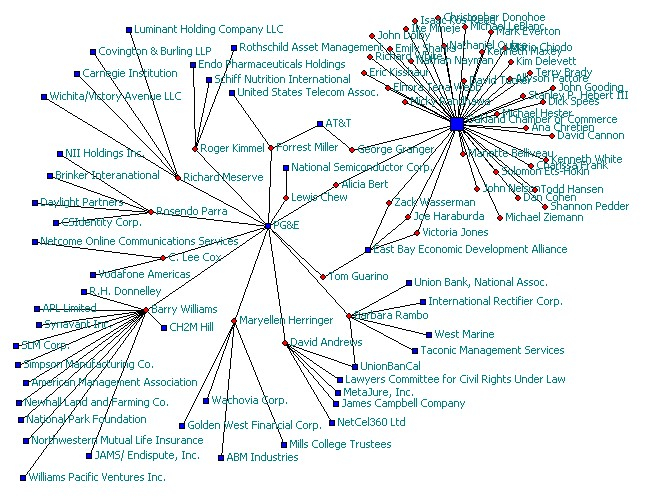
Figure 1 illustrates the core network of corporate power embodied in the Oakland Chamber of Commerce. Five board members of the Chamber in this network, identified as large circular red nodes, represent the interests of five major corporations that fund the Chamber. These five corporations have the most reciprocal ties to other companies in the entire network represented in our data set.

Figure 1., Core Corporate Network Represented Through the Oakland Chamber of Commerce: Red square node positioned at center represents OMCC board. Five large red circular nodes represent select OMCC board members. Black square nodes represent corporate entities. Small red nodes represent directors or senior executives of select corporations with OMCC membership. Selections determined by deleting pendants, leaving only directors with more than one link to the network’s core corporate entities.


1. Micky Randhawa - Wells Fargo
2. Victoria Jones - Clorox
3. Nathan Nayman - VISA
4. Alicia Bert - PG&E
5. George Granger - AT&T


If we explore the network of governance and ownership through persons linked to each of these companies, we find that often, through only one or two degrees of separation, these corporations are linked back to each other in a web of mutual governance. They share some of the same directors on their boards, and some of their directors are linked to each other by third-party corporations which they also control. This is often, but not always, due to concentrated ownership of voting shares across many corporations by powerful private equity funds (i.e. hedge funds, private equity groups, investment banks, etc.). Owning large shares of each company, a powerful investment firm uses its shares to appoint its own directors to each corporate board. When this structure of ownership is viewed from a distance, we can see how powerful corporations in seemingly divergent industries are often owned by, and ultimately governed by, the same wealthy elites.

Let’s zoom closer in. Micky Randhawa represents the regional interests of Wells Fargo Bank on the Oakland Chamber of Commerce's board of directors, but Wells Fargo's board members are interested in more than just their company's fortunes. Among Wells Fargo's directors is John Chen, chairman and CEO of Sybase, Inc., a computer software company. Chen was a director of Pyramid Technology Corporation, a manufacturer of server hardware, and later worked for Siemens after the German company bought Pyramid in 1995. Incidentally, Chen is also a director of the Walt Disney Company and a former board member of the US Chamber of Commerce.

Chen is not just a director. He is a significant owner of both Disney and Wells Fargo stock. His ownership of shares in these companies is a result of his compensation as a board member. He and his peers, who together own a large share of these companies, ultimately determine the strategic goals of both.

Chen's income in 2010 as a shareholder and director of Wells Fargo and Diseny totals $505,438. Although this is by no means his sole source of income, and only a small fraction of his total net worth, this sum alone puts him in the top 1% of America's income distribution. (At the end we have attached a detailed breakdown of income distribution in the US between 1979 and 2009 in order to demystify the so-called 1%, and provide benchmarks for understanding inequality in relation to the fortunes of those discussed here.)

Alongside Chen on the board of Walt Disney Co. is Robert Matschullat. Matschullat is a board member of Clorox and VISA, both companies with direct representation on the Oakland Chamber of Commerce board.

The Clorox company is linked back to Wells Fargo by route of other directors who also sit on the board of the San Francisco headquartered McKesson Corporation, the world's largest distributor of health care systems, medical supplies, and pharmaceuticals. These links can be confusing, but by referring back to Figure 1, we can visualize them and see how this creates a cohesive network of corporate governance and ownership.

McKesson, Disney, and Sybase (a subsidiary of the giant German software company SAP AG) are all governed by directors who in turn sit on dozens of other corporate boards, but this data has been omitted from Figure 1 to keep the diagram as simple and intelligible as possible, and also to only illustrate directors who create a cohesive network of governance among the five corporations which partly control the Oakland Chamber of Commerce.

If, however, we were to map these extended linkages, we would discern an ever expanding and relatively cohesive network of corporate ownership and governance, and we would find that these other corporations cooperate with one another to operate business leagues in other cities in the United States and beyond. For example, Kim Delevett, Corporate Community Affairs Manager for Southwest Airlines, sits on the board of both the Oakland Chamber of Commerce and the San Jose Silicon Valley Chamber of Commerce. Similarly, Ken Maxey, Regional Government Affairs Manager for Comcast, sits on the boards of the Oakland Chamber and the Livermore Chamber.

Although Figure 1 does not show these extended linkages to other corporations and business leagues, here are a few more examples we could map if we were to plug in the data: McKesson's Chief Financial Officer is a board member of the San Francisco Chamber of Commerce. Disney has placed executives on the boards of many business leagues including the Florida Chamber of Commerce and Los Angeles Chamber of Commerce. SAP AG's current CEO is a past member of the US Chamber of Commerce.

Other corporate links in Figure 1 are worth exploring in detail, so let's take a look at the networks of two companies which fund and steer the Oakland Chamber of Commerce: the Clorox Company and Pacific Gas & Electric.


The Clorox Company

The Clorox Company, headquartered in Oakland, is a multi-billion dollar business with manufacturing facilities in nineteen countries worldwide. While Clorox is most commonly associated with liquid bleach, they also own twenty brands including Brita, Glad, Hidden Valley, Scoop Away, K C Masterpiece, Pine-Sol, and Burt's Bees. Figure 2 is a network diagram emphasizing the Clorox Company's links to other corporations through its board of directors.

Figure 2., Clorox’s Core Corporate Network in Relation to the OMCC: Blue square dots represent corporate entities. Red circular dots represent directors or senior executive officers. Egonets for all corporations besides Clorox have been deleted to reduce clutter and emphasize only ties connecting Clorox directors and OMCC directors. OMCC board appears as dense cluster in upper right of Figure.


The first thing you will probably notice is that two of Clorox's directors also sit on the boards of VISA and AT&T, corporations that also fund and steer the Oakland Chamber of Commerce through their representatives on that board.

Robert Matschullat, mentioned above, is a director of VISA. Besides Disney, Matschullat is also a director of the Transamerica Corp., USA Networks, and Joseph Seagram & Sons.

Transamerica is an insurance corporation owned by AEGON, a Dutch company. It's office tower in San Francisco is internationally famous for its pyramid shape.

USA Networks is a television company owned by NBCUniversal.

Joseph Seagram & Sons was originally an alcohol distiller based in Canada, but it became a conglomerate in the 1980s by acquiring large ownership stakes in other companies, including DuPont. When it sold its DuPont shares in the mid-1990s Seagram's, under Matschullat's leadership, bought into media and entertainment companies like Universal Studios (now part of NBCUniversal — see the links and how they develop across time as companies are bought, merged, and sold?).

That Matschullat is a board member of USA Networks, now owned by NBCUniversal, and Seagrams, which used to own Universal, is obviously no coincidence. Matschulatt was a key figure in shuffling the organization of ownership and direction of these companies. Not coincidentally, Matschullat also used to be a director of the McKesson Corporation.

Clorox board members Carolyn Ticknor and George Harad are linked to one another through their past positions as a director and as CEO (respectively) of Boise Cascade, which briefly owned OfficeMax until the latter was spun off in 2004 in a highly complex corporate restructuring driven by Chicago financiers. Ticknor is also a member of AT&T, which is a corporate member of the Oakland Chamber of Commerce.

All in all, the board members of Clorox are shareholder in, or independent directors of, many additional powerful corporations and private equity groups.

Clorox director, Edward Miller, is a board member of the seemingly ubiquitous McKesson Corp.

Clorox director Donald Knauss is a director of the global construction and engineering giant URS which has innumerable major military contracts and co-manages the two US nuclear weapons labs at Los Alamos, New Mexico, and Livermore, California in limited liability partnerships that include Bechtel and the University of California.

Clorox director Tully Friedman was a board member of APL Limited, a shipping corporation that uses the port of Oakland's facilities. We'll return to APL in a moment, but first let's look more closely at Friedman.

Tully Friedman is a current and past board member of numerous other corporations that his San Francisco investment firm, Friedman Fleischer & Lowe, LLC, has bought equity stakes in. The multi-billion dollar pots of money that Friedman oversees include contributions from very wealthy individuals, many of whom sit on the boards of companies already discussed above, or who had past executive positions at these very companies.

For example, Robert Matschullat, the presiding director of the Clorox Company mentioned above, has invested part of his personal fortune in Friedman's firm. The retired chairman and CEO of Clorox, G. Craig Sullivan, is also an investor in Friedman Fleischer & Lowe, LLC. A retired CEO of McKesson, a retired chairman of Wells Fargo, and a current director of AEGON (parent company of Transamerica) are all investors in Friedman's capital fund.

Like many finance capitalists, Friedman is involved in steering national non-profit corporate advocacy groups. He is a director of the ultra-conservative American Enterprise Institute; a think tank that promotes political reforms that would further empower corporations and the wealthy.

Now quickly back to APL. Beginning as a state-owned US shipping company, APL was privatized after World War II. In 1997 it was sold to Singapore-based NOL Lines for $825 million, or $33.50 per share. Alongside Tully Friedman on the board of APL Limited were Frederick Hellman and Barry Williams.

In 1984, Frederick Hellman and Tully Friedman co-founded Hellman & Friedman LLC, another private equity firm. Although Friedman left the firm in 1998 to start his own equity group, he reportedly maintains a collegial relationship with Hellman, perhaps best symbolized by the fact that Hellman didn't drop Friedman's name from the company's moniker. Today both firms are headquartered in the same building, One Maritime Plaza in San Francisco. When APL was sold to NOL Lines Friedman and Hellman each owned more than 2 million shares.

Hellman is as blue-blooded as Californians come. He is the great grandson of financier Isaias Hellman who, among other things, created Wells Fargo Bank and occupied a seat on the UC Board of Regents for the better part of four decades. Isaias Hellman's son and grandson served as presidents of Wells Fargo, among other roles. The Hellman family's history is deeply intertwined with Wells Fargo and the UC, which are further linked together in a web of financial and political connections that deserves its own detailed analysis.

Former APL director Barry Williams is not depicted in Figure 2, but he is strongly connected to the Oakland Chamber of Commerce. Moving on to Figure 3, we will further investigate the corporate networks of power that steer the Chamber, starting with Williams.


PG&E

The network of Pacific Gas and Electric, an Oakland Chamber of Commerce corporate member, is depicted in Figure 3. Barry Williams sits on PG&E’s board of directors. In addition to his seat on APL's board, Williams is a director of numerous other companies, including the Colorado-headquartered environmental engineering giant CH2M Hill, which has a major regional office in Oakland. Refer back to Figure 1 to visualize how Williams occupies power within the corporate network that steers the Oakland Chamber.

Figure 3., PG&E’s Core Corporate Network in Relation to the OMCC: Blue square dots represent corporate entities. Red circular dots represent directors or senior executive officers. Egonets for all corporations besides PG&E have been deleted to reduce clutter and emphasize only ties connecting PG&E directors and OMCC directors. OMCC board appears as dense cluster in upper right of Figure.


Blue square dots represent corporate entities. Red circular dots represent directors or senior executive officers. Egonets for all corporations besides PG&E have been deleted to reduce clutter and emphasize only ties connecting PG&E directors and OMCC directors. OMCC board appears as dense cluster in upper right of Figure.

Like Clorox, many of PG&E's board members are the owners and directors of a vast array of other major corporations. Of particular interest in terms of the cohesive network of corporate governance underlying the Oakland Chamber of Commerce is Forrest Miller. Mr. Miller is a director of PG&E, having been elected in 2008. He is also a senior executive of AT&T.

At AT&T, Miller is responsible for "corporate strategy and development." This title refers to a school of business management thinking developed over the last several decades which emphasizes the ways that companies can systematically analyze their strengths and weaknesses in their "operating environment." The "environment" here is conceived of largely as the laws and regulations affecting a corporation's behavior, but can also mean industrial competitors and external forces like broader changes in consumer preferences or the availability of resources, labor, and other inputs.

In practice, only half of “corporate strategy and development” is about making “internal” changes to a company in response to "external" factors. The other half involves changing the “external environment.” In this respect, Mr. Miller's job entails strategizing ways that AT&T can increase its power and profits by altering existing laws and regulations, eliminating potential competitors through mergers and acquisitions, preventing competition by maintaining current telecommunications laws and policies, and gaining entry to new markets controlled by foreign states. This is why Miller is a past director of the US Telecom Association, a 501 (c) 6 business league that is organized to promote the interests of its membership, large telecommunications companies (AT&T, Verizon, etc.). US Telecom is one of the largest lobbyists in Washington D.C., spending millions each year to influence lawmakers and regulators in Congress, the White House, Federal Communications Commission, and Federal Trade Commission.

To be fair to Forrest Miller, his job, notwithstanding its elaborate title, is not particularly different from that of nearly every other corporate director or executive at PG&E, or any of the other corporate directors discussed so far. They are all intensely focused on influencing lawmakers, packing bills with beneficial provisions for their firms, shaping regulations to strengthen their control of markets, and undermining environmental and labor policies.


Who Rules?

In subsequent parts to this series, we will present more network data illustrating the Oakland Chamber of Commerce's member companies. We will also give more detailed information about the directors and executives of these companies, and provide an analysis of their social cohesion, profit-driven collusion, and political influence. More broadly, we will explore networks and institutions of economic and political power in the Bay Area. Below, however, is a brief explanatory list of the current corporations with representatives on the Oakland Metropolitan Chamber of Commerce:

1. Clear Channel Outdoor, an advertising company owning and operating billboards and other outdoor display faces, currently valued at $3.7 billion. Clear Channel owns and operates numerous billboards, bus shelter ads, and other display faces on both private and publicly owned properties in the Bay Area.

2. Swinerton, a private construction company based in San Francisco, builds for developers, government, and corporate clients. Swinerton projects in Oakland include the Ice Center, the twenty-story Essex tower on Lake Merritt, the twelve story Ellington Condominiums, and the famous "comic book" retrofit of the Oakland Police Headquarters. Outside of Oakland Swinerton has built casinos, military installations, and headquarters for companies like The Gap, Inc.

3. Pankow Builders, similar to Swinerton in scope, is a major construction company headquartered in Pasadena with a regional office in Oakland. Pankow built the Whole Foods in Oakland.

4. The global communications giant AT&T is valued at $162 billion. It has numerous operations in the Bay Area. AT&T's economic reach and political influence are too expansive to detail here.

5. PG&E, the region's behemoth investor owned utility, operates gas and nuclear fired power plants in California, and owns much of the state's electricity and gas distribution grid and pipeline infrastructure. Headquartered in San Francisco, PG&E is valued at $15 billion. Its profit margin is highly dependent on California state laws and regulations. Thus PG&E fields an army of lobbyists across all levels of government.

6. Securitas is a Swedish private policing company that hires out security personnel, including guards and investigators, to secure corporate property, wealthy residential associations, and high net worth individuals, among other glittery things. Securitas has a regional office in East Oakland, and is valued at $21 billion.

7. Southwest Airlines operates in the United States and is headquartered in Dallas, Texas. It is valued at $5.8 billion. The Oakland Airport is a major hub.

8. Grubb & Ellis buys, owns, and sells real estate. The company leases out several hundred thousand square feet of office space in downtown Oakland, much of this right along Broadway between 20th and 15th Streets. The company's business model is predicated on increasing land values in Oakland and other cities. Grubb & Ellis is headquartered in Orange County and valued at $21 billion.

9. CIM Group is another real estate corporation, specializing in ownership and management. It's headquarters are in Los Angeles. It's regional Bay Area office is at 1333 Broadway in the 1 Kaiser Plaza building, a 28-story office tower the company owns and manages. CIM Group owns over 1 million square feet of office and hotel real estate in downtown Oakland. The company's business model is predicated on increasing land values in Oakland and other cities.

10. Colliers International is yet another real estate company that brokers much square footage in Oakland, especially downtown on Broadway, Harrison, and Franklin Streets. Colliers leases out office space in the Wells Fargo Bank Center building on Harrison, among other corporate properties. The company's business model is predicated on increasing land values in Oakland and other cities.

11. Sunwest Bank is a business bank headquartered in Tustin, a city in Orange County, California. It's Oakland office is at 1999 Harrison in the Lake Merritt Plaza.

12. Summit Bank is an Oakland-based, privately owned bank with assets between $100 million and $3 billion.

13. Waste Management transports and disposes of residential, industrial, healthcare, and construction wastes. The company has an Alameda regional office and contracts with the city of Oakland and other regional governments to haul trash. Headquartered in Houston, Texas, Waste Management is valued at $14 billion.

14. Clorox, a consumer products company, is the largest corporation headquartered in Oakland with a market value of $8.4 billion. Located one block from Oscar Grant Plaza, the corporation's executives have long been involved in Oakland and the East Bay's politics, even though the legislative and regulatory issues the company is most focused on are federal.

15. Comcast, another telecommunications giant valued at $57 billion, specializes in cable. It counts the Bay Area among its largest markets. It's economic reach and political influence are too expansive to detail here.

16. VISA is headquartered in San Francisco on Market Street. The credit card company's entire business model is predicated on helping banks and other lenders intensify consumer debt. Visa is worth $61 billion. It's main corporate campus is in Foster City in San Mateo County.

17. Bank of America was headquartered in San Francisco until 1998 when it merged with NationsBank. The company, valued at $52.4 billion, counts California and the Bay Area among its biggest consumer and home loan markets. Bank of America absorbed Merrill Lynch during the financial crisis in 2009 and now operates Merrill as its investment bank subsidiary.

18. Wells Fargo is still headquartered in San Francisco. Valued at $123 billion, it counts California and the Bay Area among it biggest consumer and home loan markets. Wells Fargo absorbed Wachovia during the financial crisis in 2009, and retired the Wachovia brand in October, 2011.

Source: Congressional Budget Office. “Trends in the Distribution of Household Income Between 1979 and 2007.” October, 2011. http://www.cbo.gov/ftpdocs/124xx/.../10-25-HouseholdIncome.pdf